Classic Florence

I am very lucky. As some of my roommates gloom about in homesickness, I feel like I am home. This is because somehow, I have persuaded an army of people to come and visit me in Florence.

This is good for two reasons. One, I get to see the people that I care about and I’m not totally alone as I wander about Europe. And two, it forces me to stop messing around and go see actually Florence stuff!

When you’re studying here, you live here. This is home. And just like any other home, you start to take it for granted. Have I been to the Uffizi Gallery? Uh, no. Have I been inside the Duomo Cathedral? Um…no. Have I have Florentine steak? Nope. Have I eaten a ton of gelato? YES! Yes I have.

But anyway, my point that I was getting at is that when people visit you, you are forced to actually do something during the week besides sit on your ass. You are forced to do the same cool stuff that tourists do, even though even the word “tourist” fights the word “cool.”

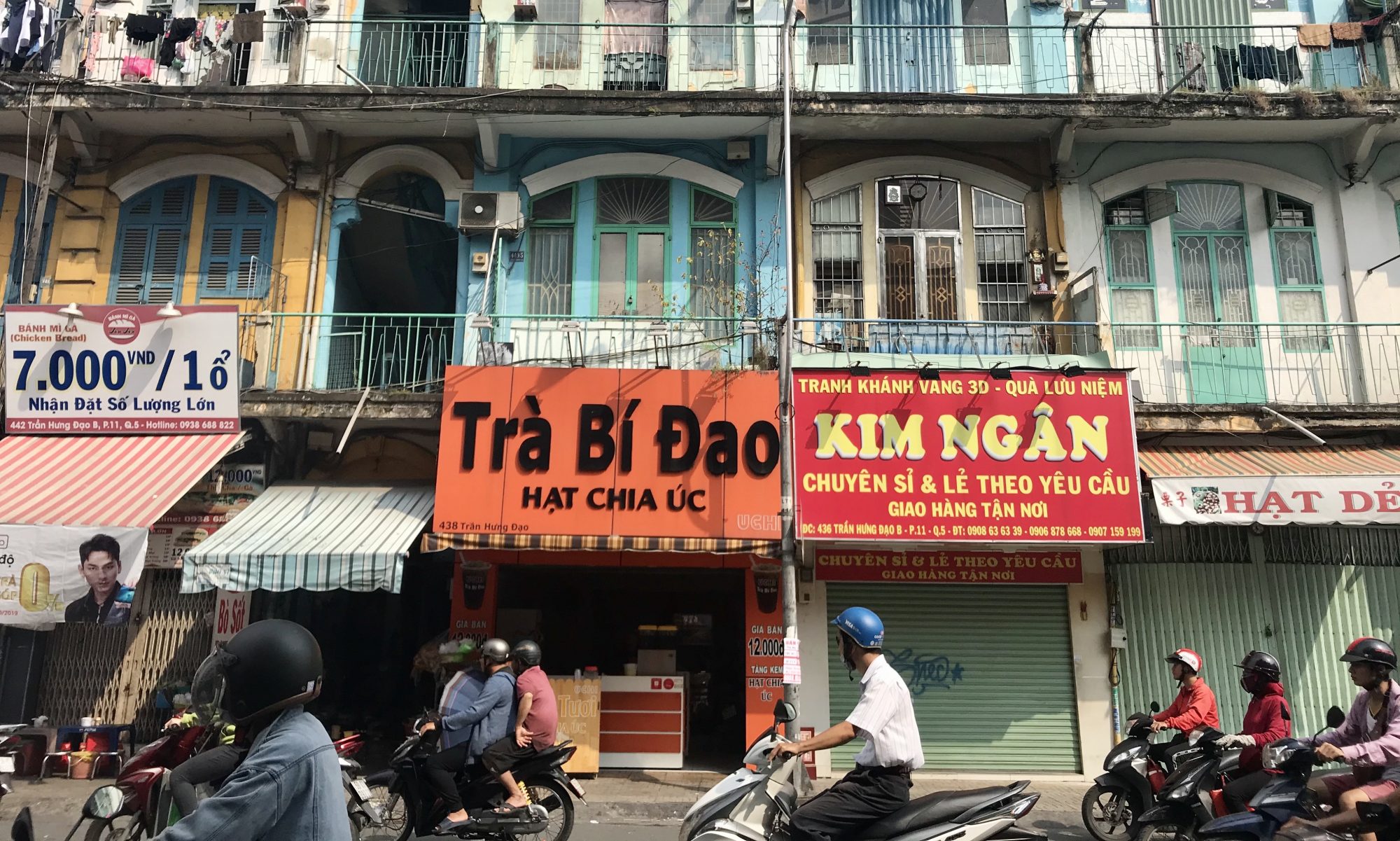
So when my boyfriend visited me last week (Grandma comes this week!) one of the first things that we did was trek up to Piazza Michelangelo, a pleasant little square, as Rick Steves informed me, that boasts one of the best views of the city. Unfortunately for him and myself, I was feeling it a little bit after some wine at lunch and I literally took us an hour in the opposite direction of this famous square across the Arno. And “an hour” is being gratuitous to me.

Quick and easy hike, Rick? Um, I think not. Seriously this is a goddamn JOURNEY. I thought I was in shape. I was sadly mistaken. I was sweating just looking at the pile of steps that led up the Square that is adorned with a fake David and tons of tourist shops. When we finally got there, I wanted to stay for hours just to make it worth it, but there isnt really much to do besides take a couple of pictures, listen to some music, eat some gelato, and watch the occasional wedding. Sounds awful, doesn’t it?

Another thing that I dragged my boyfriend into doing is climbing the Duomo, the beautiful landmark that chills right outside my window. I figured it was about time I climbed the 463 steps, being that I live there and all and I love it like its my parents. So we paid the eight euros, stood in the line that- take note here- clears out by the afternoon, and began the trek up the ancient and tiny steps that circle the Duomo.

Once in a while throughout your steps, you have the chance to glance out the little windows, which tease you with their ascending views as you climb Florence. Whenever you start to feel a little tired, you see the encouraging messages people have scratched all over the walls, like…
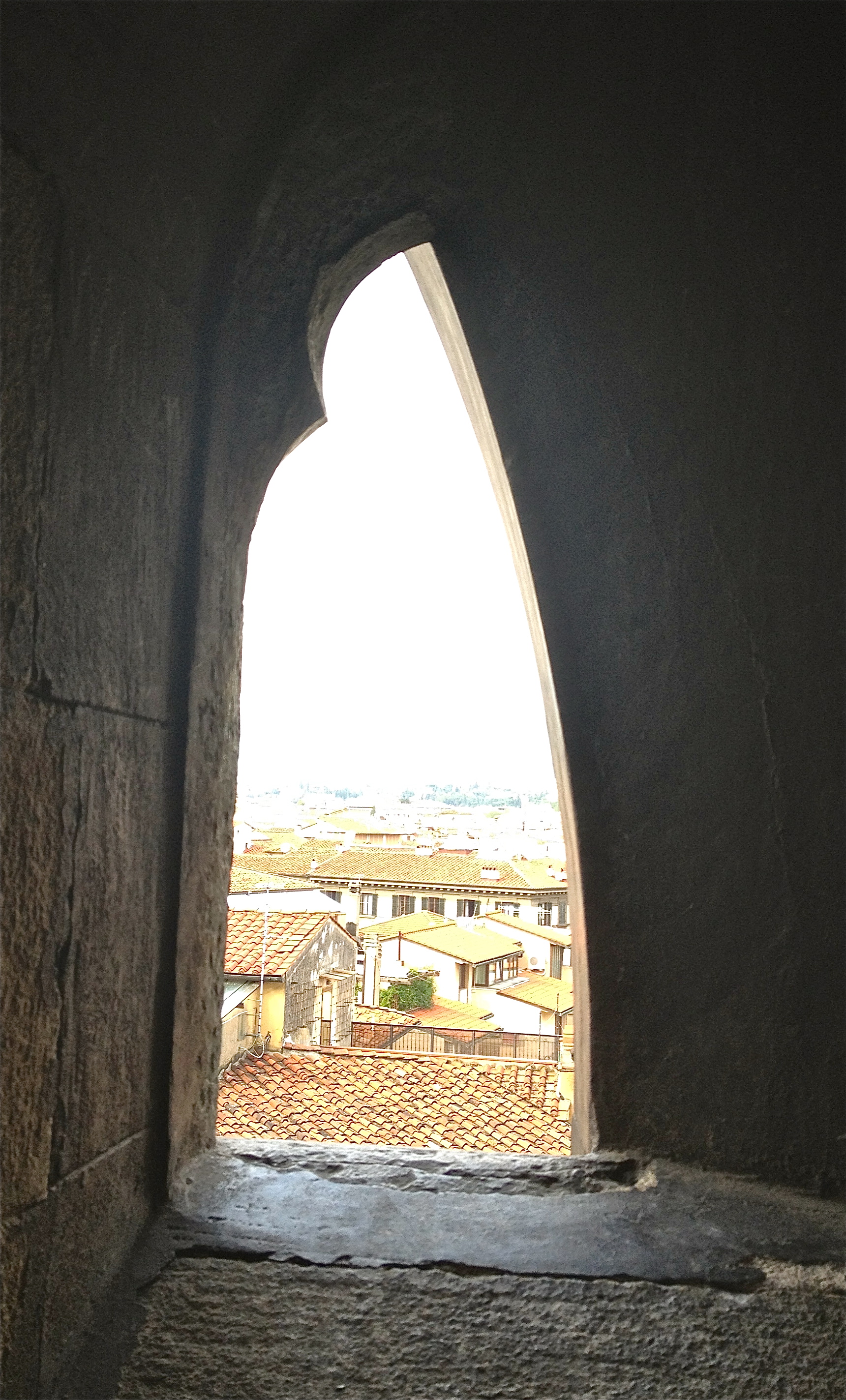
Keep going. The view is seriously worth it. 

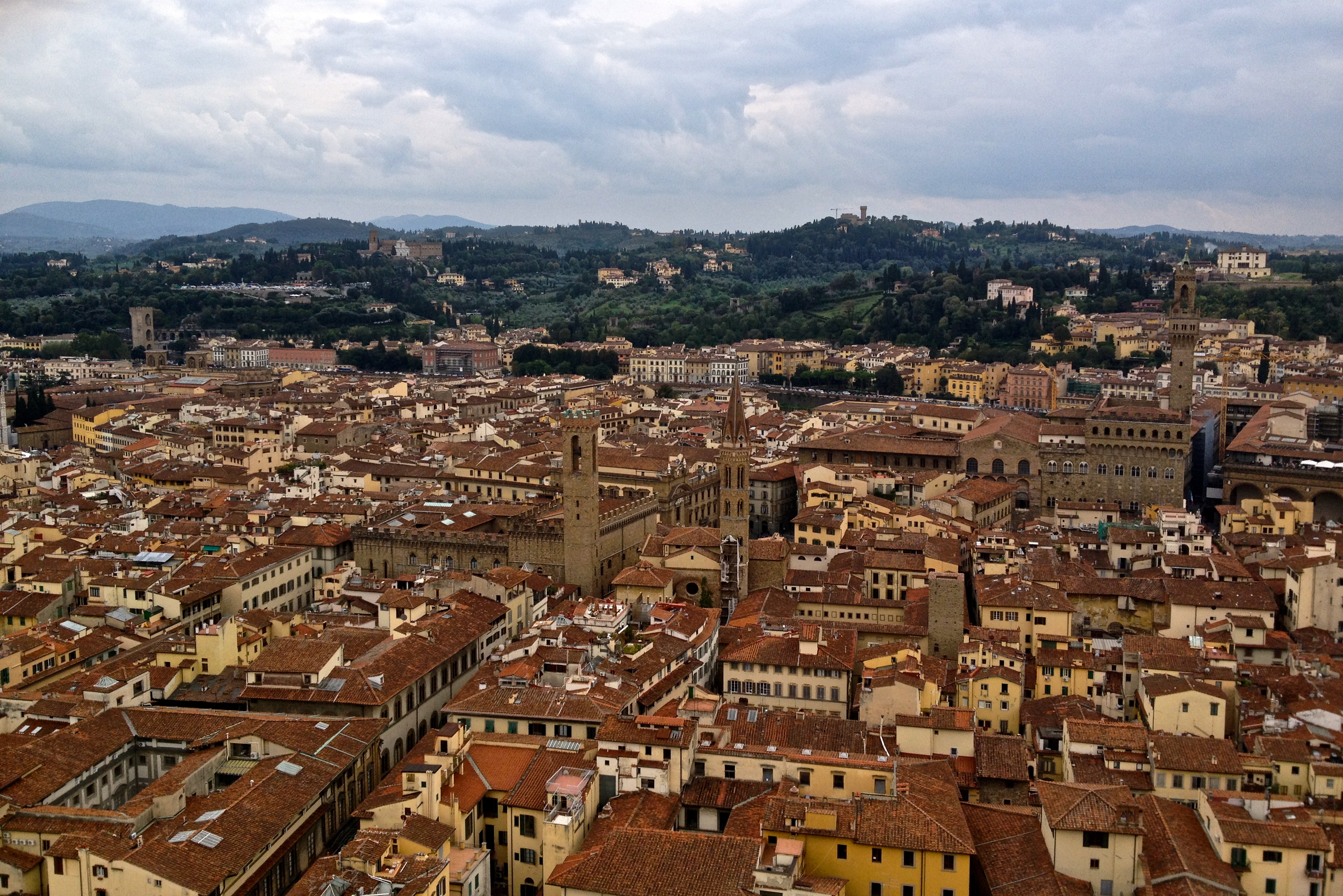
And then when you finally get to the top… you’re there. This is way better than lame Piazza Michelangelo, because you’re getting a 360 degree view of this fantastic countryside and the Tuscan hills that surround it. Yet another reason why the Duomo is seriously awesome.
The Wine Country

Florence is a beautiful place. It is bustling with Renaissance architecture, ancient museums, yellows and greens and grays. Siena, however, which is really only a short drive down the road (about an hour and a half, which is nothing compared to the 12 hour bus rides I’m used to) is not like this. I’m actually not totally sure why everyone told me that Siena has always been in competition with Florence.

Unlike Florence, Siena doesn’t really look very Renaissance-esque (but then again I’m not entirely sure what this would look like, besides having Florence as an example). Siena is a city of the Medieval, a place that looks like it would be best friends with Edinburgh, Scotland.


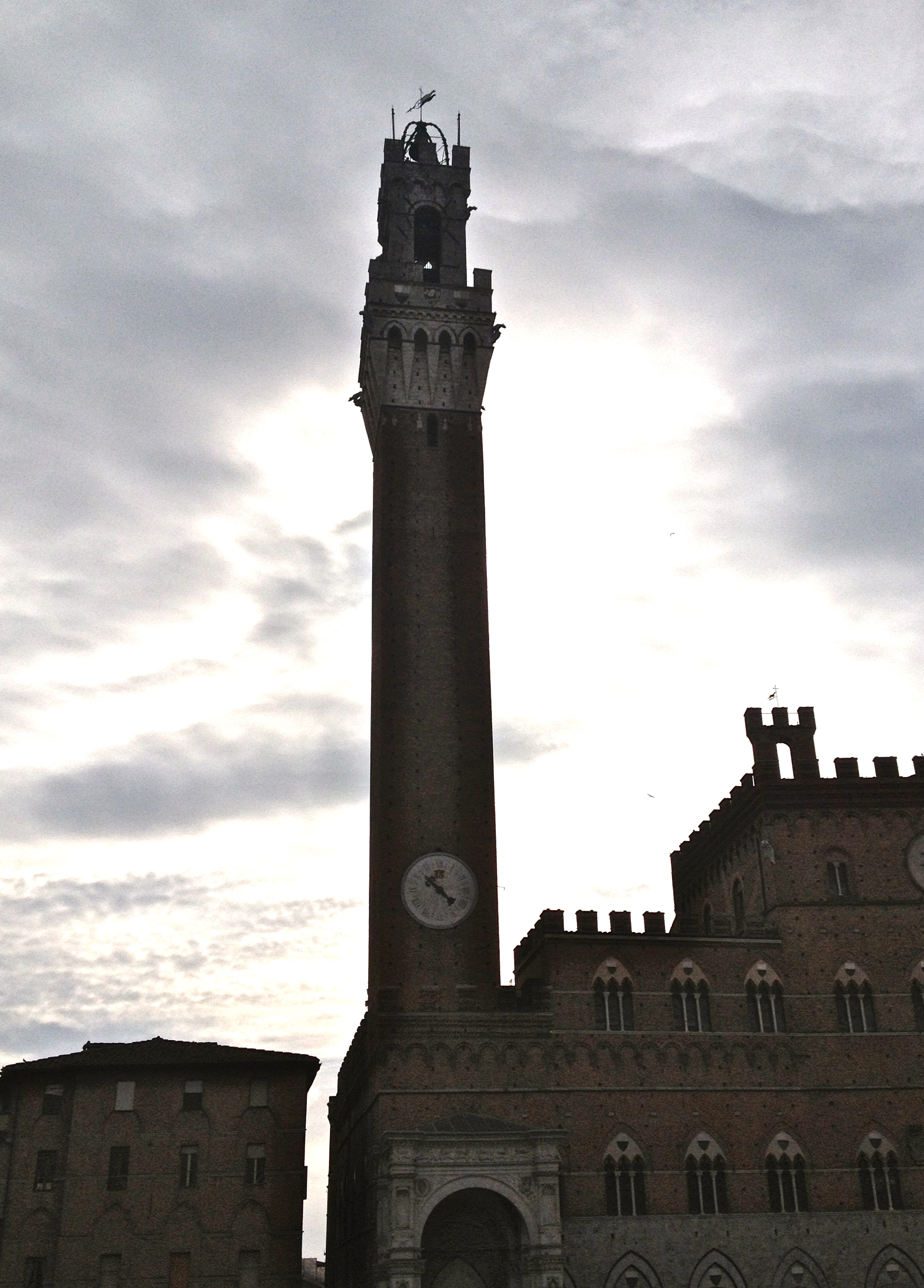
Siena is a little place, however, and there doesn’t seem to be a ton to see. Our Bus2Alps tour guide, Tiernan, took us to the city center, Piazza del Campo, which literally looks like a big stone field. This is also the site of where Il Palio takes place. After roaming up one of the city’s many hills (it overlooks the Tuscan countryside) we find the Duomo, which looks remarkably similar to my Duomo in Florence, although a little smaller. Apparently, this Duomo was on its way up to being bigger and better than mine, but then the Black Death came around and people had a lot better things to do than build ginormous churches.

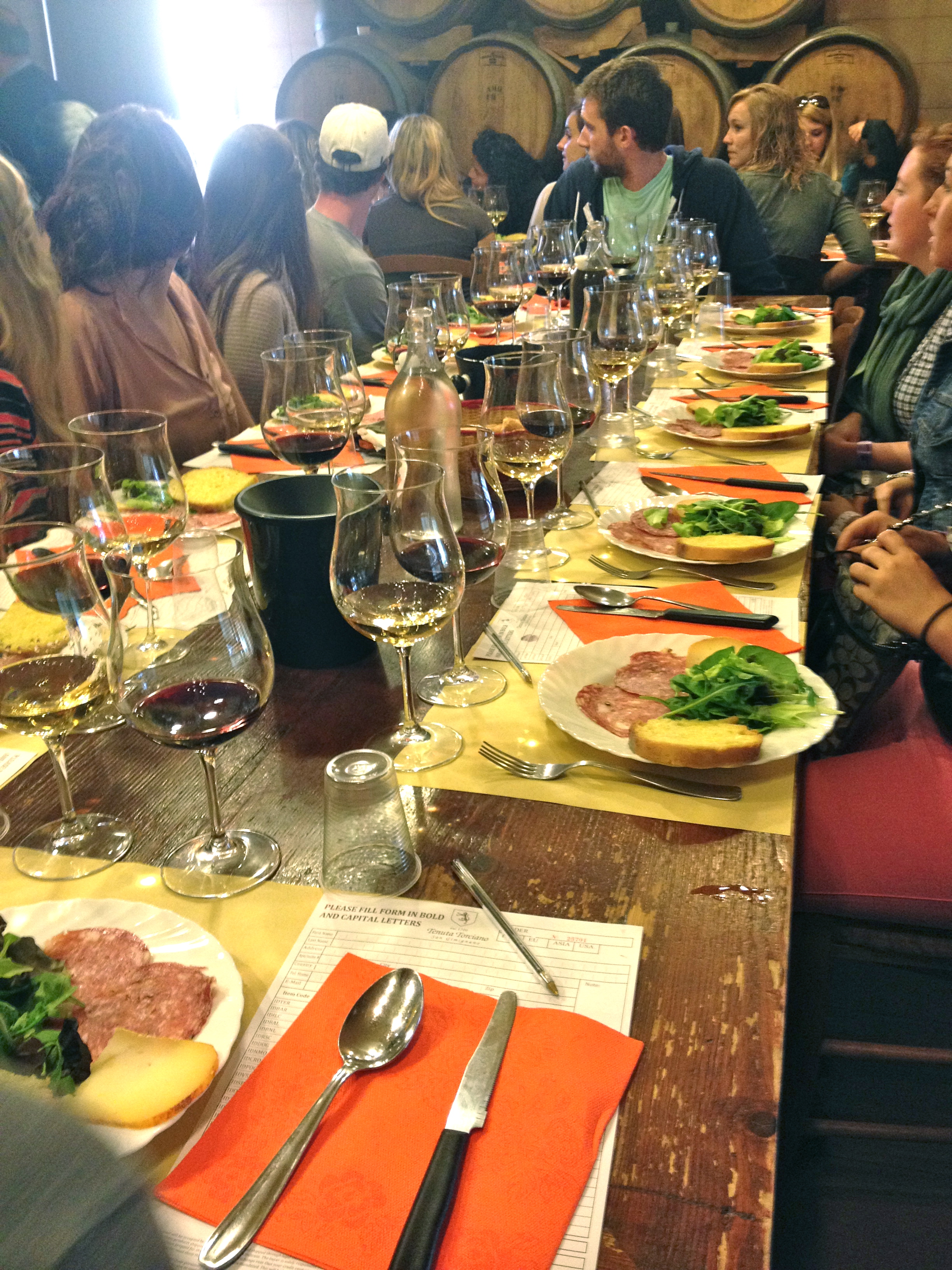
After this short little tour of Siena, Bus2Alps took us to our next destination– a local winery called Tenuta Torciano. When I see all the pretty horses roaming about in their fields alongside the squares and squares of grapes, I know that we have come to the right place. We are led inside to a little house where a man who speaks very little English literally serves us eight glasses of wine each. And this isn’t the three euro wine that I find at the cheap grocery store down the street. I can taste the alcohol in this wine. But I’ll be damned if I have to spit it out before the next glass is served– I chug that wine down along with our meal of oily bread, salad, some kind of potato dish, lasagna, and biscotti.

The drunker we all get, the better friends we are. I make best friends with every person sitting within a five foot radius and I start to actually wonder if I’m going to vom on the bus and why I can’t see anything and it’s 1:00 pm. After we stumble out of the winery and the Italian man tries to sell us wine, we all wander the grounds for a little bit, running in and out of willow trees and playing with the geese and ducks that hang around in the sunshine.

We all shuffle back on the bus and I’m still not sobering up. What a surprise. Our bus tries to crawl up the hills, but it seems we have a lack of oil, so Tiernan, our guide, and the owner of Bus2Alps have us come outside and we begin to walk to San Gimignano. If I was sober, I may or may not be frustrated by this. But instead, I am PSYCHED, as everyone else seems to be. We run up and down the ninety degree roads and take pictures, our sobriety coming back in the sunshine. It is a beautiful day for a bus to break down, let me tell you that.

Finally we get to San Gimignano, which is another medieval city similar to Siena. We climb up some more hills to get to the wine museum/castle and we take dopey pictures as the Bus2Alps crew buys us more wine from the museum, which we sip overlooking the countryside.

Back down at the main square, we eat gelato, which is supposedly the best in the world (I think Florence’s is better). As we eat our gelato next to the fountain in the center, it begins to pour and pour and pour. I wonder if anyone even noticed.

Yes, This is Pandora.

So even though we all literally want to die because the pub crawl robbed us of whatever energy we had left and those hostel beds are seriously awesome, we get up at a nice ripe time anyhow to go on an island hopping tour of the islands lining Croatia. Not a bad way to start the day. The second we climb onto the little ferry and take some places on the roof to listen to some music and gander at the sea, boat staff are coming up to us and pouring shots. Please God, NO. No shots. Seriously. It’s 8:00 am.

It’s pretty relaxing to cruise down the Dalmatian Coast, which boasts crystal-clear blue waters and nice views of the marina that hugs Split as well as the never-ending line of white marble buildings that look like they were once fit for a king but now host little restaurants that line the sea. We listen to music once our heads stop thumping and after some time of chilling in the boat, we get to our first island, Solta.

Unlike basically every other place I have ever been to, Solta, or really Croatia in general, hasn’t been sabotaged by tourists quite yet. Croatians are excited to see us as they ask us if we are from California (well jeez, I wish) and a couple of the Croatians hang out up to their knees in the ocean with naked babies and pretty dogs that hang around. It’s a pretty empty island, so we mostly just buy some food and floaties for when we go to the beach later.

Back on our boat, the staff serves us lunch, in which I once again get a whole fish. Unfortunately, I think someone nabbed this one out of the nearest fishbowl and it’s really kind of nasty. Whatevs. Throw it into the ocean, that’s where it came from anyway. They give us wine too, and let me tell you I am no wine connoisseur, but this is the nastiest wine I have ever had. I’m a senior in college and I can’t even chug this stuff down.

Then, we climb back to our perch on the top of the boat and blow up our floaties. Mine has little orange fish all over it and was clearly made for a toddler. Awesome. We boat to the next island, Brac, which is a lot bigger than Solta but is still totally devoid of any tourists whatsoever.

After getting off the boat, we start the hike to the Golden Horn, a beach that is famous for looking like a triangle with trees in the center. We wade around in the freezing cold water a little bit, and then I actually pass out on the beach, which is the best slumber of my life. This beach isn’t littered with tourists and isnt cliched like Mexico or other tourist destinations. It’s hidden from the world and seems delicately pressed into the side of the land, surrounded by trees and filled with deep blue water that looks good enough to drink.

That night, we don’t go to one of the surrounding towns of Split like some of the other students do, but we stay in Split to see the Diocletian Palace by nightfall, which is the most complete Roman ruin in the world. The town is literally built around these ruins and it actually looks a lot like a castle. Wonder why no one booked this place for us to stay.

After seeing the Palace and wandering, we do some more exploring of Split and hike up the mountains a little bit to find a nice place to eat. Thank God for me, the dollar kicks the Croatian kuna’s sorry ass, with $100 being equal to about 575 kuna. We eat at a restaurant that I would usually count on my grandparents to take me, and my entire seafood-pasta dish with a house red wine comes to about nine euro. Why did no one tell me to study abroad here?

Is This Pandora?

Okay. So think for a second. What do you know about Croatia?

Yeah, that’s what I figured. Me neither. And this is precisely the reason why I booked a four-day trip there with Bus2Alps, starting out with a how-could-you-say-no 10 hour bus ride. This actually sounds a lot worse than it is. In reality, I find it pretty nice to show up at the train station in my pajamas, squeeze myself into a bus seat, pop some NiteQuil, and wake up to the sun rising in another country. Doesn’t sound too bad now, does it?

A tour guide from Bus2Alps that we have traveled with before, Tiernan, told us that Croatia looks like Pandora. I was a little skeptical, because come on now, what kind of place looks like Pandora? We’re not in damn Australia over here, we’re in Europe. However, once my NiteQuil wore off in the morning and I scrubbed the pillow face lines off of me, I could see pretty clearly that she was right.

Driving into Split, the city we were staying in (and one of the major cities of Croatia) it was neat to see the towering apartment buildings that look more like little pods more than anything else, their soft edges seemingly swaying with the breeze. I’ve been to beaches before, people. I have been to a lot of beaches. But when that beautiful beach is next to a city made of white marble with tan-skinned Amazon people who speak a language that sounds as unfamiliar as German or Norwegian? Uhh yeah. We’re not in the Bahamas.

After we check into our hostel, Goli & Bosi (“Naked and Barefoot” in Croatian), we run upstairs to explore a little bit, a pretty impressive feat considered we just slept on a bus (again). The entire place is highlighter yellow. And I mean EVERYTHING is highlighter yellow. Definitely a nice way to wake up in the morning. All of the room numbers are written on the floor, along with the entire history of the world. Every floor corresponds to a century. Walking into our room, we see that the seven beds have been packed into the walls, looking like little private pods packed into the tiny room.

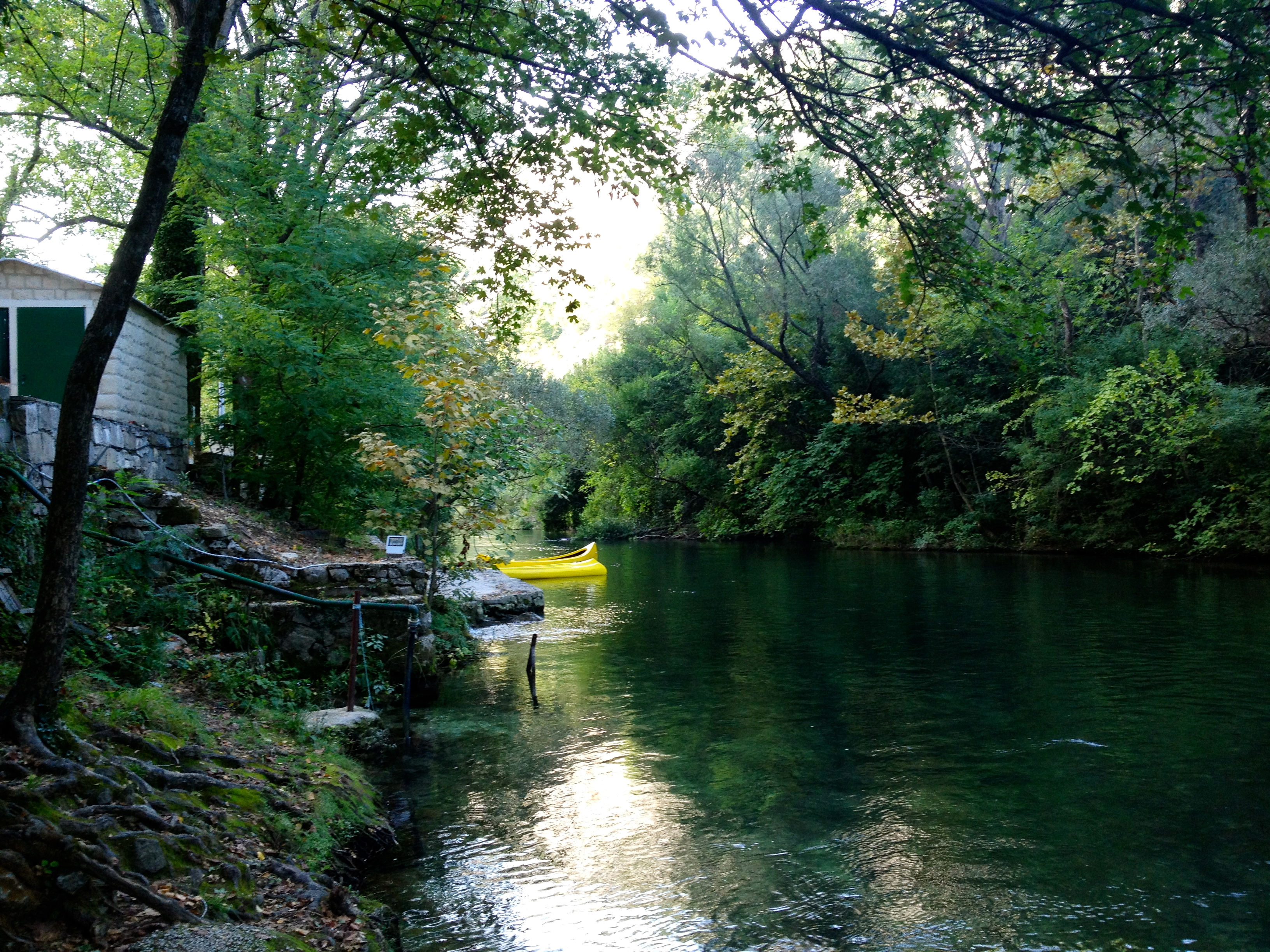
Soon after, we shuffle out to go to our tour of the Cetina River VIA WHITE WATER RAPIDS. I’m not much of a rafter (I don’t really like dirt… or cold…) but if there’s a place to white water raft, this seems like the place to do it. Plus it’s hot as hell outside. Good deal.

We are all given wetsuits and boots, which seem unnecessary at the time given that it’s literally like 90 degrees outside. After shimmying into them, it’s hard to refrain from taking Power Ranger pictures. Our tour guide, a big hefty Croatian man named Stefan with beautiful blue eyes, tells us in his cool and collected English how to paddle and basically not die. After we prove that we are a worthy team, he invites us to take a jump into the water.

Umm literally the coldest water of my life. Five seconds in and we are begging Stefan to let us back into the raft. This wetsuit has done nothing for me except for maybe make me colder. Stefan shows us how to pull ourselves into the raft, but of course, no one can do it, so he holds out his arms for us to grab onto to pull us in. It is at this point that the Big Crazy Croatian comes out.

ONE, TWO, THREE, OPAAAAAA! he yells as he literally throws us into the boat.

Paddling down the river, it’s clear that these rapids aren’t really as intense as I was hoping, but Stefan steers us well and tells us of his days as a professional rafter (didn’t know this existed) and how his Croatian team went to the world trials. He tells us how he loves to surf and bike, and looking at the guy, that was pretty obvious anyhow.

About halfway down the Cetina River, we stop at some cliffs and Stefan invites us to jump off of them. I hate to say it, but I stayed in that damn boat. Jumping from a cliff into water that’s colder than an ice bath? No thanks, pretty sure I already have hypothermia anyhow.

We boat past a little farm with horses that literally just run wild, with only bells around their neck for their owners to find them. Stefan says that they always come home anyway- who wants to sit out in the rain? It’s nice to see the natural streams and the Croatian countryside and mountains, which look remarkably similar to the Amalfi Coast and Cinque Terre.

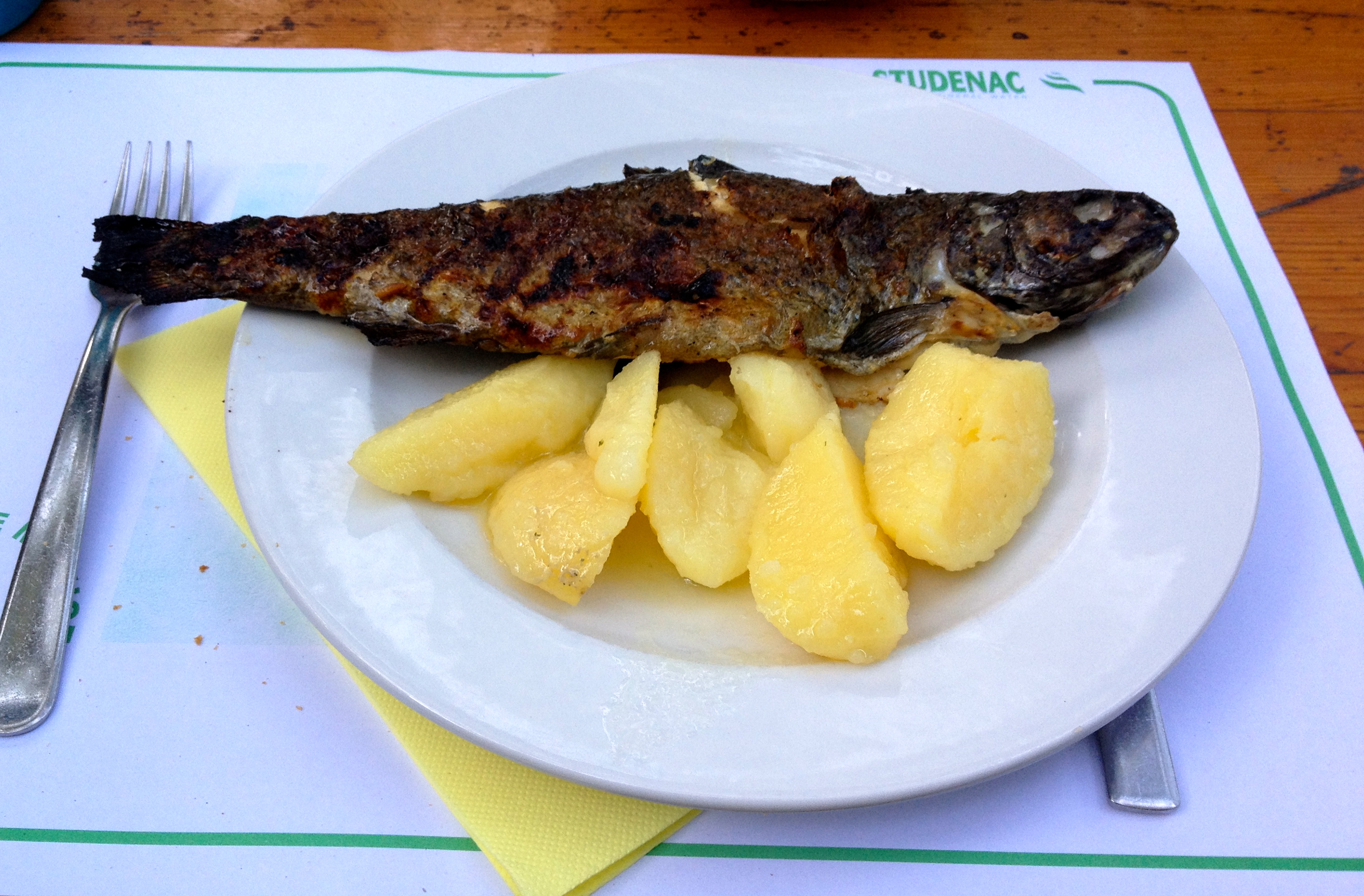
At the end of our leg of the river, we stop at an old mill alongside the water to have dinner. I ordered the seafood… which is a whole fish. Not a fish filet. A fish. With eyes and bones and a face. I have to cut this off with my eyes closed just so I can eat it, and even still, I am picking out bones the entire time and possibly choking a little bit. None of this seems to matter though when you are literally eating the best meal of your life. People make grossed out faces when my fish is served, but I really don’t care, because it is seriously awesome.

That night, we sign up for a pub crawl throughout Split. At the first pub, there is open bar, in which our bartenders gladly make us strong drinks of cheap vodka and soda, because hell, I am getting my 20 euros worth. My favorite part of this isn’t actually being in the bars (however of course this is great too), but really, it’s wandering Split, a city of marble, with a drink in my hand as we clamor through tiny alleyways and rosebushes.

The Rich History of Modern Munich

The next morning, we give Oktoberfest a rest for a little while and we go on a bike tour, hosted by Frankie’s Bike Tours, of Munich. At first, it’s pretty difficult for me (once again, a damn little person) to get on one of the huge white bikes, especially drive it around a city that is full of people who can actually bike, buses, cars, and tourists. I ask God to please, please not let me die today.

The tour is pretty cool though, where we stop at a casual enough looking place, Hofbrauhaus Beer Hall. Apparently, though, it’s a place where Hitler gave speeches and the Nazis met up. We also stroll by The Residenz, which is where the Bavarian dukes lived and is a copy of Palazzo Pitti in beautiful Florence. By the Theatinier Church, me and two other girls I am with, Bianca and Colleen, touch the faces underneath the Four Lucky Lions to give us eternal good luck. We stop and eat at the Englischer Beer Garten, which is the second largest beer garden in Europe and has more awesome German food. Apparently, somewhere outside the Hofgarten (the main garden/park in Munich) there is also a man-made surfing wave where people bulk up on their wetsuits (it’s friggin freezing outside) to ride the waves.

With absolutely no help from our Florence for Fun tour guides, we find the main metro station in Munich after our bike tour and we go to the Dachau Concentration Camp, one of the largest concentration camps that existed in Germany. In the cold rain, it is even creepier to walk through the gates that read “Work Brings Freedom” in German. As we walk down the same path that the Jews walked down to enter the camp “for their own protection,” as the Nazis told them, I can’t imagine what it would be like to never return after just a few hours in the bleak place.

It reminds me a lot of a large, abandoned ranch, with its wide open spaces surrounded by big gray buildings that stuffed 36,000 people inside a space meant for 6,000. Outside of the barracks are big lots where people had to stand for hours each day for Roll Call, and outside the barracks are poles that people were tied up on as torture. At the very end of our walk through the camp, we go to the crematorium on the far left of the camp and we walk through the rooms that people were gassed in and the fake showers that exist there. Seeing things like that make you actually feel the souls that are trapped inside, the thousands and thousands of lives that were lost for nothing.

The Adult Disneyland

I’m sure that you have been to kid’s carnivals before. I’m sure that you have eaten sandwiches sold to you by sleazy vendors, you have bought dopey t-shirts, and you were probably a little buzzed since you were most likely drinking in the parking lot. And even though many of these things have a lot to do with Oktoberfest, held every year in Munich, Germany, trust me, they are not Oktoberfest. They are just not.

Sitting on an eight-hour bus ride to Munich at 11:30 pm was really not my cup of tea. I can barely sit in a car for an hour and when I first sat down I was wondering what exactly had possessed me to do this. A rando named Amanda from Michigan sat next to me, who seemed nice and chatty enough, but she became a little too chatty so I gave her some of the NiteQuil I had brought with me. The last words she said to me that day were “Can I have the extra two pills?” Yes, yes you may.

Coach buses are actually pretty comfy after a couple of these babies. But anyway, we got to Aoho Hostel a little bit early, where we dropped off our bags and began walking over to Oktoberfest. I stayed with my newfound friend and we chatted as we walked the fifteen minutes or so down the otherwise boring street to Oktoberfest. We didn’t have any maps, we literally just followed all of the people that had on dirndls (the traditional German dress) and lederhosen (the traditional German men’s pants and suspenders). Munich was not really what I had suspected as we walked down to the fairgrounds, with its big windowed buildings that looked more like New York City than a German city that had seen World War II firsthand.

At 8:00 am on a Friday, Oktoberfest wasn’t really in full swing yet when we first walked through the grounds, but it was clear people were ready to roll when we saw the huge mobs and lines outside each of the 14 tents, some much more popular than others. I figured anywhere that had beer was good enough for me, so we walked closer to the end of the line (which looked a lot like a Frat Row) until I saw Lowenbrau, a tent that I had vaguely remembered someone telling me was a good one.

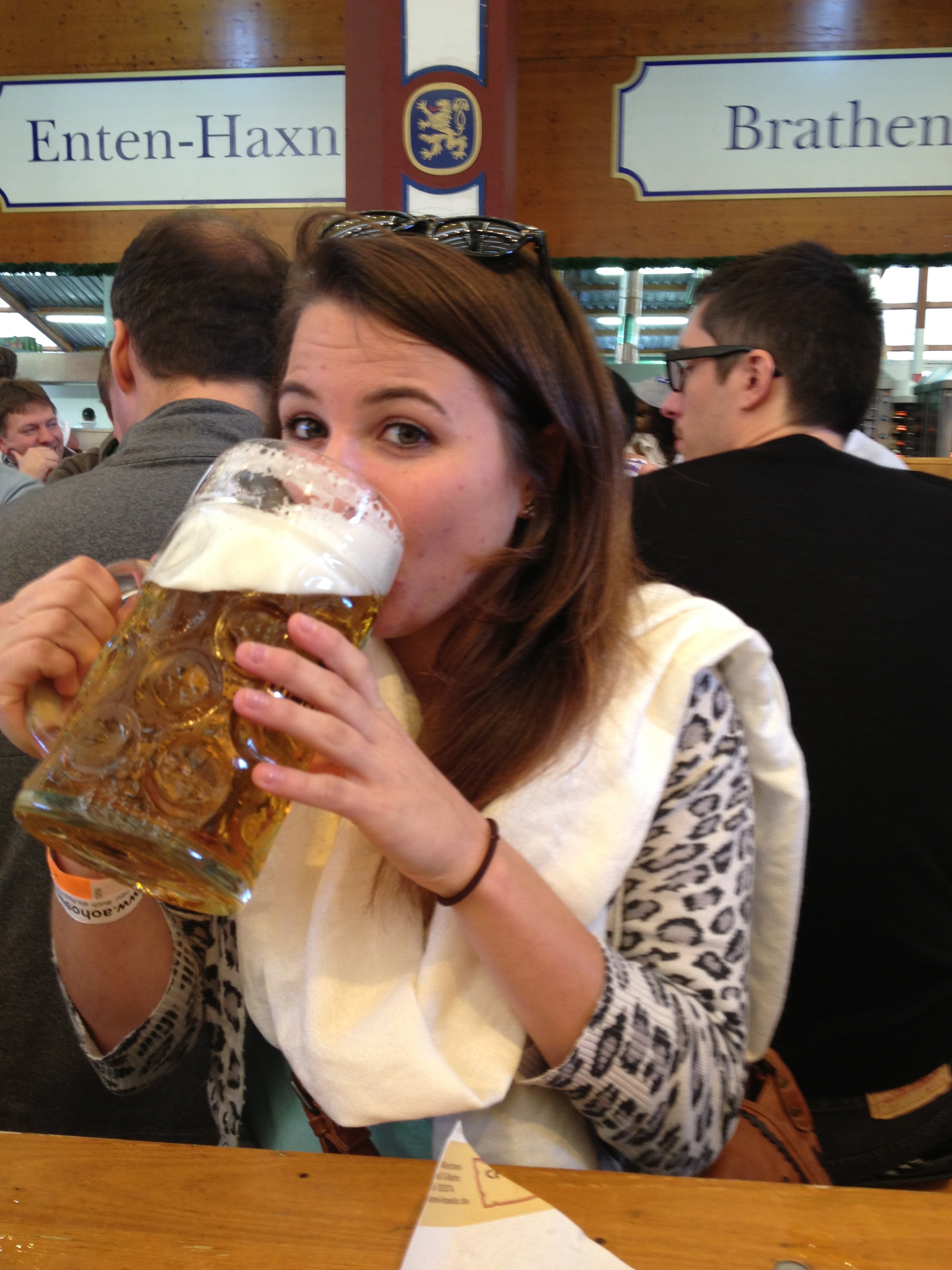
It was chilly to stand in the mob and basically count the minutes until 10:00 am when the doors actually opened, but a few minutes before, the lion statue atop the tent, the symbol of Lowenbrau, begins to roar and drink its beer and everyone goes nuts. People begin to try and mob the three doors to the front of the tent, but a couple of huge German bodyguards rumble out and although I can’t understand a word of German, its obvious by their thundering voices that you better get the hell out of the way until they say so. When the doors finally open exactly at 10:00 am, I grab Amanda’s hand and we slide through the doors among at least a hundred other people to claim a spot at a table close to the center of the tent.

Domandigo sits next to us, a guy in his early 30’s who is from Rome and speaks little English. He is with his silent and scary friend who I assume is also Italian. Things are a little awkward at first, but when Domandigo buys us each one beer and then another, I am suddenly a natural at Italian. Domandigo tells us that tonight, we will dance and dance as he asks me if Amanda has a boyfriend and tells us that he is a professional cyclist and his friend is the owner of Lowenbrau. Soon after, another group of men sits next to us, big bustling loud men from God knows where who have some kind of beer group t-shirt on. I chat with the one next to me, Andre, who is Brazilian but lives in Belgium. When his friends begin chanting his name and banging on the tables, Andre stands on the bench and casually chugs his huge beer as the whole room erupts in screaming and applause. When Andre sits down, his eyes are glassy and red and there is a line of beer staining his shirt, but he is smiling.

Oktoberfest beer is not like a Keystone, people. You pay around nine euro for a big, bustling stein of the German beer, which is less carbonated than American beer so you can chug more and you feel less shitty the next day but you get more drunk. I am a little person, but one beer is definitely enough for me and Amanda was absolutely hammered by three.

Coming out of the bathroom or even leaving your table for a minute, if you are a girl, you are bound to be absolutely mauled by every boy who walks by, telling you, in his drunken stupor, that he loves you and you are beautiful and there is a place for you in his bed. Their glassy eyes tell it all, and I shuffle away from them and back to my table where I dance with Andre to the live music in the center and finally, hustle Amanda out since she can now barely stand.

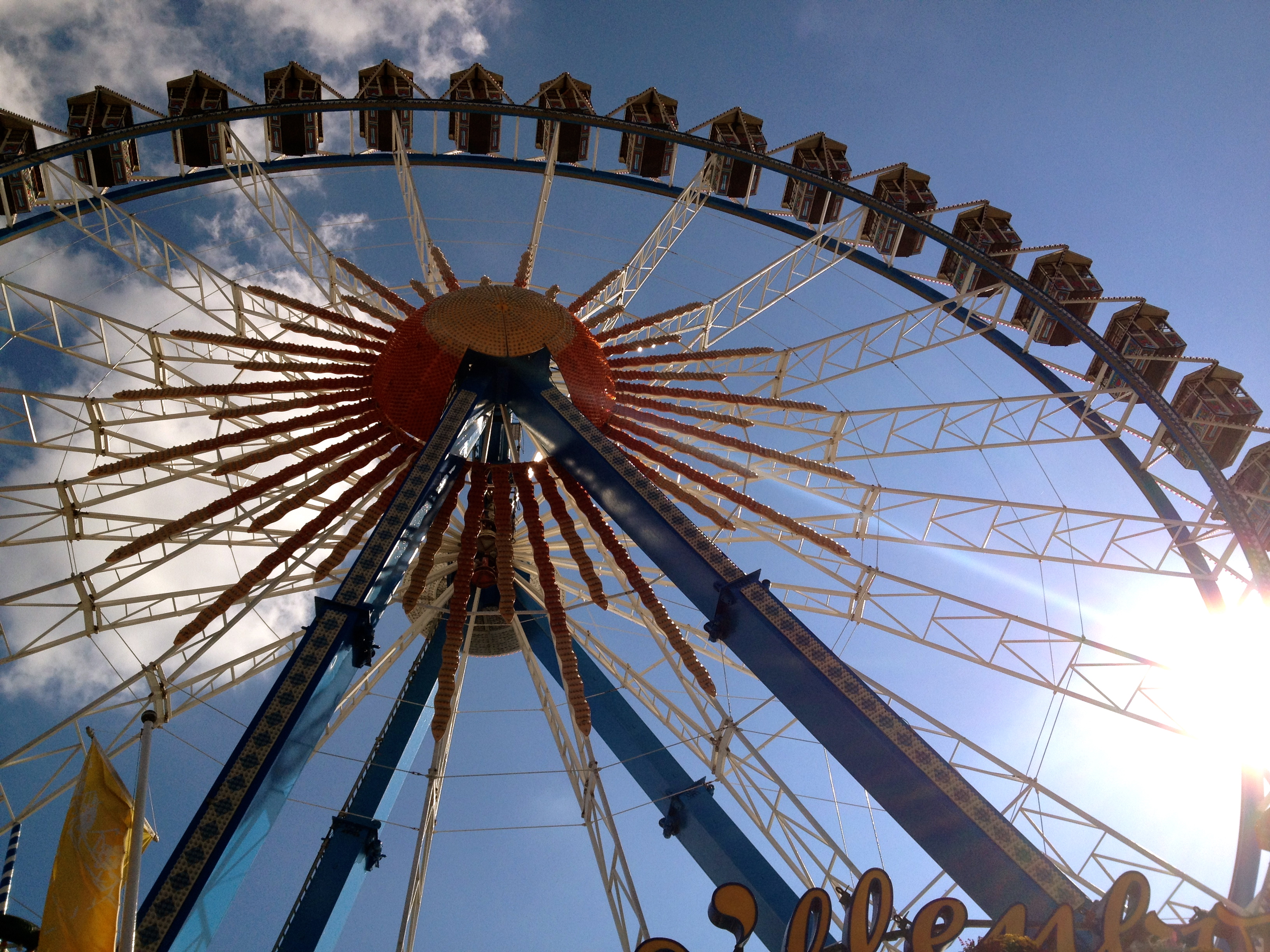
Wandering the fairgrounds in this kind of stupor feels weird. I feel guilty when I see all the kids around and I wonder if their parents know I’m feeling it, but then I figure they probably are too. I can’t imagine what would possess anyone to get on one of the many rides in this kind of state, like the big colorful roller coasters or swings or bumper cars, which look awfully pretty in the rare German blue sky. I buy some bratwurst and miss nussen, which is literally the best drunk food I can ever imagine. This sure beats a frat party in the States.

A Day in the Mountains of Norway

The next morning, Trygve, Turid, Kristin, Sissel, and I drive to their beloved cabin in the “mountains” (when to me, this entire country is a mountain) which is somewhere in the wilderness between Bergen and Voss. I’m a little confused when I see the cabin across a river, but when we park on the other side, Turid explains to me that to get to the cabin we have to hop a guardrail, walk a little downhill and then cross a short bridge and some rocks to get there. Wearing my nicest jacket and a borrowed pair of Wellies, I actually laugh aloud when I think of a real estate agent in her heels 20 years back telling Turid and Trygve, “And here we have the romantic entranceway of… a river…”

Trygve, Sissel’s tall and quiet brother, is the stereotypical strong and silent type, only speaking when spoken to and taking on all his fatherly duties with a quiet confidence. He lights the wood stove as Turid, a teapot-looking woman with a permanent smile on her face puts some pastries on the table, called “shillings” (they look a lot like cinnamon rolls and only cost a shilling back in the day). Kristin gives us a little tour of the modest cabin, showing us how her parents have expanded the cabin over the last 20 years. She shows us all the bedrooms, in which Turid has handmade the quilts.

When Turid and Sissel go outside to sit on the deck and drink tea, Trygve, Kristin, and I go for a hike, which seems to be a favorite activity of this family. As Trygve marches forward, I chat with Kristin, who at first glance is stern and dignified and may intimidate me just because she is a teacher of English and German at a high school in Bergen. Her hair is usually pulled back and she speaks in a tight British accent, as she got her Masters in English in York, England. But within five minutes of talking to Kristin, she’ll tell you how she literally has an apartment stuffed with books she loves and how much she adores teaching, even if she’s living in a village in Thailand and waking up at 5:00 am everyday, as she did a few years ago when she taught English abroad.

In the first leg of the hike, we go through a gate and pass through an old farm, which wraps around one side of the lake that the cabin overlooks. A little hoard of sheep blocks our way, which someone has oddly locked on one part of the bridge, but they scatter as soon as we start to walk through. Going up the all-uphill first half of the hike reminds me a lot of Colorado with its rolling hills surrounded by mountaintops dotted with snow and ice. Waterfalls are all around us on the tops of some of the mountains. As pretty as it all is, it feels good to finally collapse in a heap by the wood stove before driving back to Bergen on the little wraparound roads.

That night, we walk next door to Trygve and Turid’s son, Andreas’, house, where he lives with his wife, Katrina, and their two blonde children, Sandra and Guru. We have a traditional Norwegian dinner of tacos and Spanish wine (well paired, as my teacher, Giancarlo, would say). I start to see how American/Norwegian/or anything else doesn’t really matter over a bottle of wine and well-deserved meal after a long day, because no matter what the continent, everyone can smile about the same things.

An Outing with the Fam

When you’re a stubby brunette with an obnoxious laugh, it’s easy to feel out of place in a sea of white-blonde heads on tall beanpoles in Bergen, Norway. Luckily for me, by some miraculous mix of fate, my grandmother was born in Norway and her brother, Trygve, and his family still live there, making for some interesting family vacations.

So while everyone else in my study abroad group danced on tables in Munich, Germany, for the first weekend of Oktoberfest, I got on a plane and headed to the underdog of Europe. I was happy to discover that the weekend I visited wad the first three days in weeks that it hadn’t rained. And let me tell you, rain is not what you want in a country where you wear jackets in July.

On Friday, when Trygve was at work, where he owns a printing press, and his wife, Turid, works for an environmental group, my grandmother, Sissel, and I took a bus into Bergen. Bergen is the second largest city in Norway to Oslo and is only a short ride a way from my family’s house about fifteen minutes outside of the city.

Bergen is not very reminiscent of a big bustling city like New York or Milan. Instead, water flows in and out of it into  fjords (like a large river), and the city itself is dotted with thatched roofed colored buildings in red, yellow, blue that are older than America. We got dropped off in the city center, which is right in the middle of the daily fish market next to the marina.

Vendors hassle us to buy crabs, shrimp, and fish with their eyes and scales intact. We try some reindeer, elk, and whale, which surprisingly all taste basically the same and remind me of salami, just a little thicker. My father back in New Jersey used to tell me that one of his favorite memories of his sole trip to Norway when he was ten-years-old for Trygve and Turid’s wedding was the bustling fish market and an old man with no thumb chopping fish next to his stand and yelling at little kids as they stared.

This all makes Bergen very storybook, especially when the sun is shining and the boats are coming in. Even though it’s a cool 40 degrees Fahrenheit today, quite colder than my home in Florence, the sun warms us up quickly and soon we are dropping layers behind bushes and buildings to pick up later.

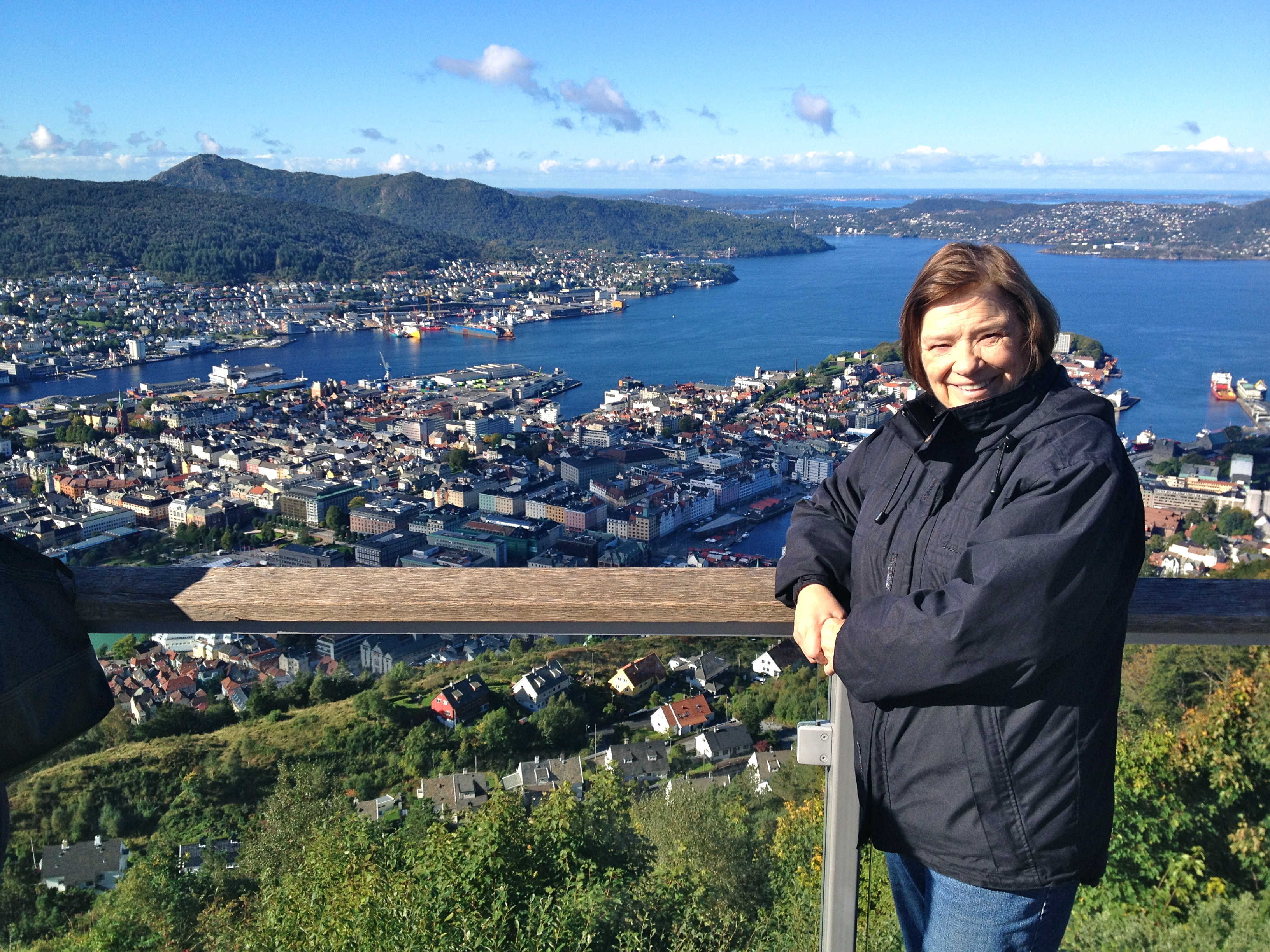
Sissel and I take the cable car up to Mount Floyen, which seems to be a favorite spot for hikers and bikers, even though it’s like an eighty degree angle. At the top, we look over Bergen and soon trample through the forest to the wooden troll statues that are scattered amongst the trees, covered in moss and ivy. As I huff and puff on the trek back down Mount Floyen, my 76-year-old grandmother parades down in her Norwegian sweater like she was born here or something.

After having lived in Bergen for 20 years, Sissel didn’t see much else for herself and packed her bags to see her uncle in Brooklyn for what was supposed to be six months. At some kind of dance, she met my grandmother, Sal, a stout, loudmouthed Sicilian who ran around with a gang. Once she made him dump his other girlfriend, they married and had three boys, including my father, Anthony. Sissel has since forgotten most of her Norwegian (and many words have changed over time anyway), but she stays true to her wandering ways with at least three trips a year to places like Utah, Barcelona, and Alaska… basically anywhere she can get a ticket.

My grandmother and I shop a little in the shops of Bergen soon after, although I’m sad to see that the krone (pronounced chrone-a) is currently kicking my dollar’s ass. Norway has free healthcare and college tuition, but their taxes are through the roof with a whopping 25 percent sales tax.

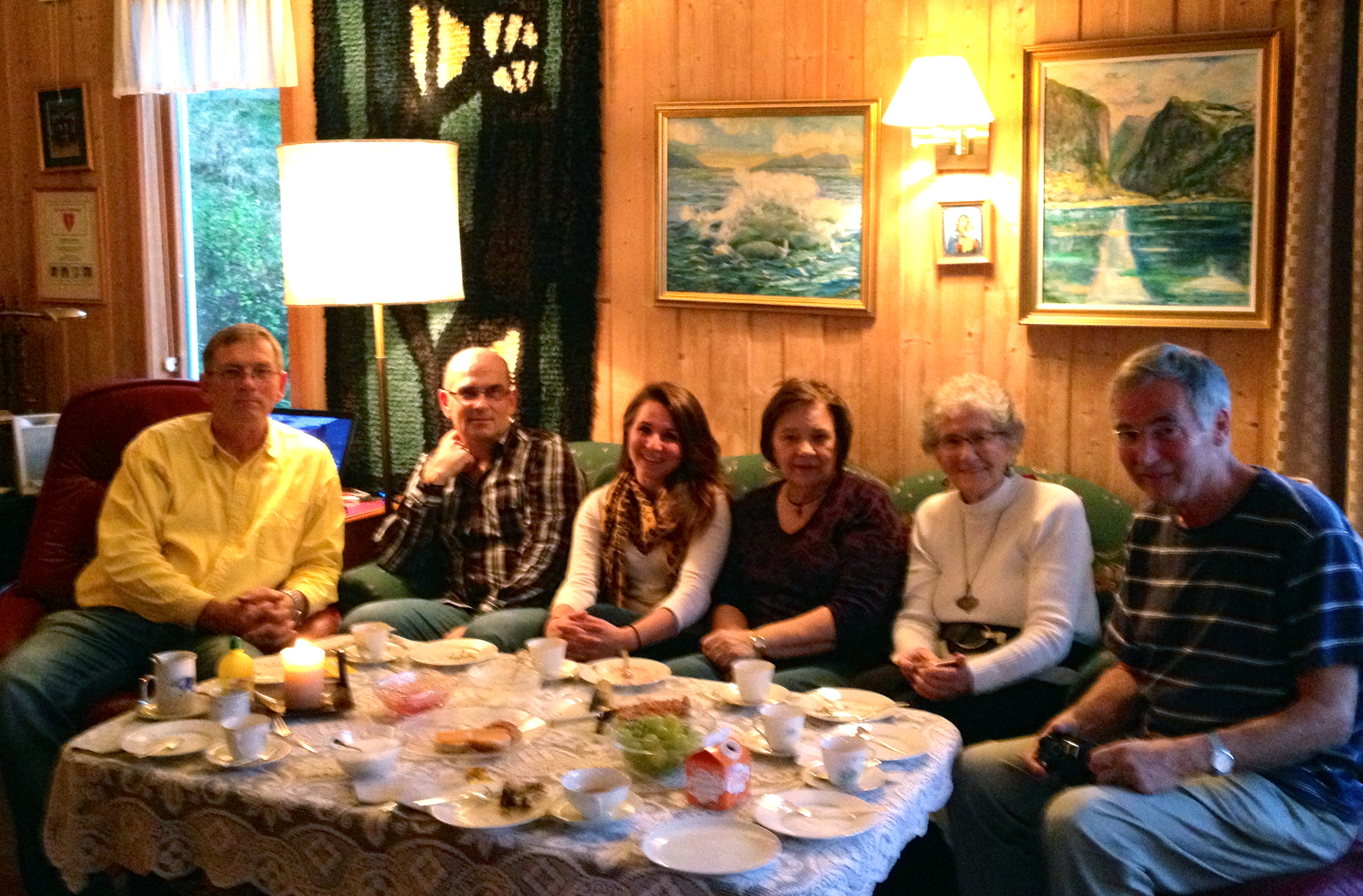
That night, Trygve, Sissel, and I drive to my great-great aunt’s house, which is perched on a mountain a little more into the countryside. Like everyone else in Norway, she lives in a wooden house that overlooks a fjord. She’s well-dressed for an 88-year-old and especially lively as she nudges us inside and hands us little knitted slippers to wear on her wood floors before she serves coffee and apricot cake in a living room full of photos and flowers.

Back at home, Trygve, Turid, Sissel, Kristin (their daughter who lives in the apartment upstairs) and I sit around a table in the living room by the fire reading books and sipping tea. It’s literally the sanest family time I have ever been a part of (ours at home usually consists of someone screaming and/or throwing an object within the vicinity) and, thinking of it now, no one even turned a television on once.

Venizia, la Citta di Amore

Sitting on the Florence for Fun bus at 8:00 am with a small Italian man with a major cigarette problem was not the best way to start our day in Venice. Luckily for us (and all tourists, really) this does not make this place any less cool.

The only way to get into Venice is by train (since, um hello, the city is on canals). After the short train ride there from our three-hour bus ride from Florence, we emerged from the rather royal-looking train station to see a fistful of traffic… of boats. Instead of clamoring to find a taxi outside of Penn Station in New York City, we stood there and hopped on line to get on a taxi boat, which is pretty nice what really is a taxi. Standing in front of Canal Grande, the main canal of the city, is actually a little unnerving. On the one hand, the image is very familiar, yet on the other hand, you’re in Venice and you’re surrounded by grand palaces that dot the Canal.

Our little angry Italian tour guide shepherded us onto the taxi boat and pointed out some of the key sites, which mostly consist of beautiful buildings and architecture that are extremely gaudy and gold and romantic, like Santa Maria della Salute and Ca’ d’Oro. I’m sure you have seen loads of pictures of Venice that are photoshopped nicely with gondoliers and couples and pinks and reds and blues and greens. Well guess what. IT LOOKS JUST LIKE THIS. My pictures look the same as the ones on the postcards, because this city is friggin gorgeous. It’s hard to tell what’s someone’s apartment and what’s a restaurant and what’s a palace. Unlike other cities, when you see buildings falling apart and their scaffolding coming loose you don’t think, “Ew, gross.” You think, “This place is sick.”

Image

I can’t really imagine what it would be like to drive my little boat to the grocery store and park it in the garage… that’s in the water. Obviously, it’s insanely expensive. But it also seems to be a little inconvenient and inefficient to me, and the fact that this city functions at all is really a mystery. When there is high tide (which seems to be pretty often) the city workers set up giant tables- literally folding tables- for people to walk across as they gander in St. Mark’s Square or wherever else. When you have an apartment on the ground floor, you have to either seal up the entire bottom half of your door or have some really sick steps. If you have a baby in a carriage, fuggetaboutit. You’re better off in… well not Florence either… I dunno, maybe Jersey?

Walking through this city retains its romanticism in some ways, like when you see gondoliers in their red-striped shirts lounging by their gondolas and little dogs wandering around. We were lucky enough to get on a gondola for a decent price (usually it runs for about 90 euro for 45 minutes), and even though we heard that being a gondolier is a great honor and you can only do it if it’s been in your family for generations, our own gondolier said he is the first one and was confused when we asked, and he also doesn’t really like it because “the hours are long and he really doesn’t have time to hang out with his girlfriend.” When we asked him to sing for us, he said that he only sings in the shower, yet all of us were welcome to join. The romanticism continued to fade when he chugged his Gatorade from behind us and then accidentally knocked it into the water with his foot. Go figure.

Piazza San Marco (the main square) is neat too, with the romantic Basilica di San Marco and Palazzo Ducale and the super cool Winged Lion, which is the symbol of St. Mark (the city’s patron saint). When Napoleon crushed this city, over 1,000 lions were taken in an attempt to crush Venetian pride, but as a Venetian mason was hired to do this, many lions were “accidentally” overlooked (according to Florence for Fun information).

We also got to see a glass blowing demonstration. Sounds lame, right? Yeah I thought it would be too. UM NO. COOLEST THING EVER. Davide, a guy who sort of looks like a modest lion himself, heated up the glass in the furnace and then sculpted a horse in like thirty seconds with the hot glass. I need to learn to do this.

Image

Sometimes when I go on Facebook and whatnot and I see what my friends are doing at the bar, I’m actually a little sad and I miss them and just being with all these people at home, doing what I do best (running around like a maniac). But then I take pictures like this and I just feel like a jerk.

See a Wonder of the World for Fourteen Euro

As the rest of our group headed off to the Amalfi Coast for the weekend, my roommate Andrea and I set our alarms for 10:00 am (yes, this is necessary) to hop on the train to Pisa for the day. After paying a measly seven euro each and missing a train (this is a learning process, people) we got to Pisa, which was only about an hour away by train. When you drive as much as I do, an hour seems like an obscenely long time. But when someone else is driving and you get to gander at the Italian countryside, it’s really quite pleasant!

Anyway, Pisa is an odd place. When you’re in Italy you kind of expect cities to land in a few different categories– ancient, beautiful cities like my Firenze (it’s nice to feel like “it’s so good to be home” when you’re studying abroad), modern, expensive cities like Milano, and picturesque countryside towns like Lucca that ooze romanticism and make you want to skip. Pisa is not like any of those. It’s a little dirty and there isn’t too much going on.

Don’t get me wrong. I’m sure that there’s a couple nice sights in Pisa that don’t include one of the Wonders of the World. But I’ve never heard of them and I forgot my travel guide that day. So instead of trying to see it all, Andrea and I bought a map for 1.50 and crossed Fuime Arno (the main river that crosses the city) and walked the mile-or-so to the Square of Miracles, which houses the Leaning Tower and a couple of other buildings no one really cares about.

The only miracle in the Square of Miracles is that there is a fair amount of green grass, one of the only spots I saw in the city, that is actually quite cozy in the sun and seems to be a good place for tourists to lounge after they took their photos. It’s pretty pleasant for such an ugly city, really.

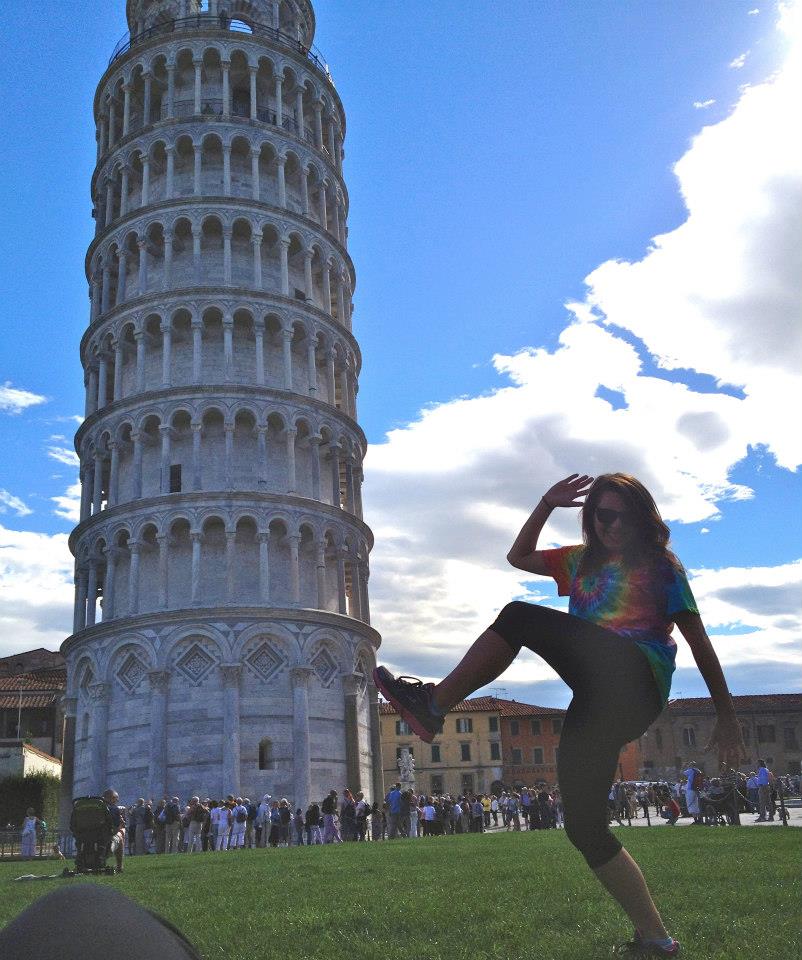
The Leaning Tower, which is mobbed with tourists in stupid positions (myself included) and their significant others laying on the grass trying to take their pictures, can be climbed if you’re willing to pay up and stand in a really long line. Otherwise, you can try to read the information poster on it, but nowhere on it that I saw does it explain why the damn tower, which was built in 1174, leans to one side. So I’ll tell you why.

In good ol 1174, the Tower’s architects didn’t realize that the soil was unstable and the three meter foundation would be insufficient. Uhh, whoops. After the first three stories were done, the ground sunk some and the Tower began to lean. While Pisa was at war with other republics, construction stopped for about a century, which was for the best because it let the soil settle. When construction began again, the engineers built the upper floors with one side higher than the other to compensate. Each year, it leans about a millimeter more, and in my own uneducated opinion, that baby is doomed.

Spend the fourteen euros and the few hours of your life is this picture is worth it to you–

(I think it is).

Image